Part One - When AI Writes the Code, Who Fixes the Bugs? Why Agentic Remediation Is the New Control Layer
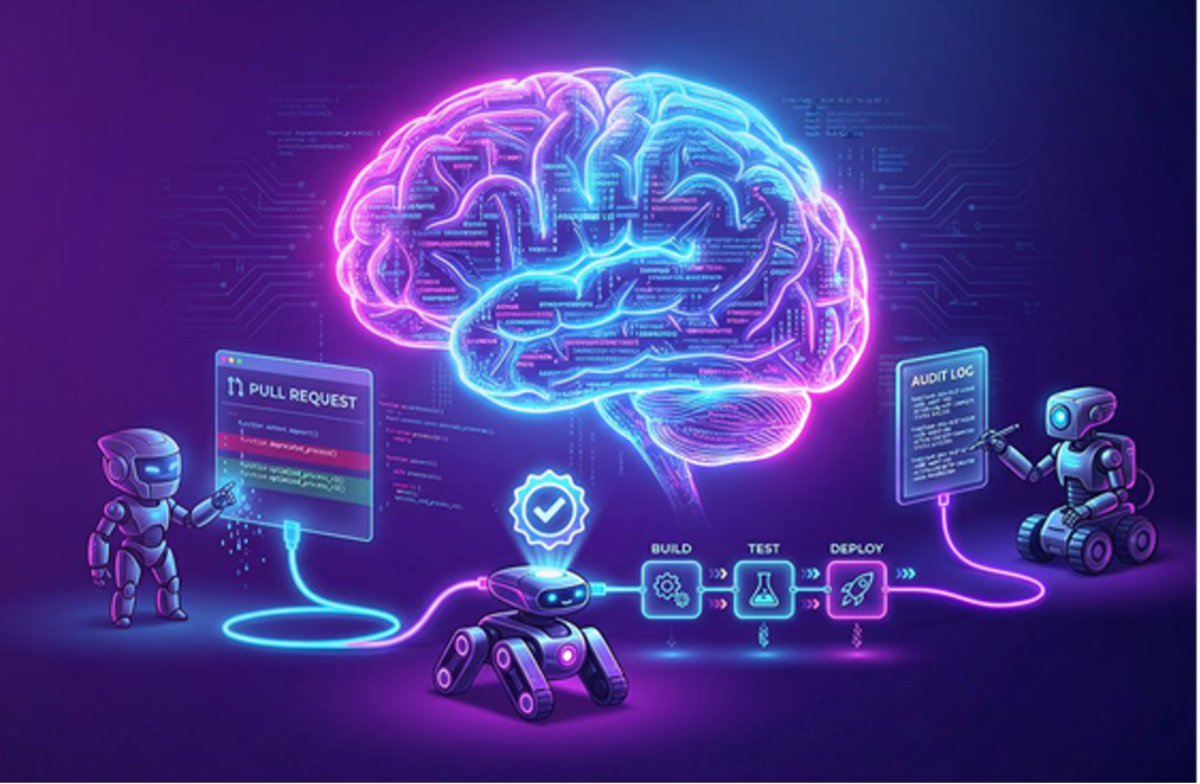
AI now writes a massive slice of your codebase. Without an agentic remediation layer, it can also quietly rewrite your risk profile.
Key Takeaways
- AI now generates 30–50% of enterprise code, but traditional AppSec still assumes human authors, clear intent, and linear workflows.
- Remediation for AI-generated code is slower and riskier because developers lack context for code they didn’t write. In some studies, repeated “AI refinements” increased critical vulnerabilities by 37% instead of reducing them.
- Agentic remediation flips security from detection-first to correction-first: autonomous agents discover AI-generated code, propose fixes, validate them, and document every change.
- Multi-agent architectures, AI-BOM/PBOM tracking, and code-to-cloud context are emerging as the core building blocks of this new control layer.
- CISOs should treat 2026 as the execution year: discover AI-generated code, pilot agentic remediation on low-risk systems, enforce rigorous validation, and scale deliberately.
- Platforms like Cranium can extend this model beyond a single repo, providing continuous AI security and governance across code, pipelines, models, and runtime.
The New Reality: AI Writes the Code, Attackers Read the Fine Print
AI coding assistants have quietly become your busiest “developers.” Depending on your org, 30–50% of new code now originates from tools like GitHub Copilot, CodeWhisperer, Windsurf, or Cursor. That’s great for velocity. It’s brutal for assurance. Incident queues are swelling with issues tied to AI-generated logic:
- Missing input validation
- Over-permissioned APIs
- Opaque dependency chains no one remembers approving.
Security teams are being asked to triage and remediate code they didn’t design, can’t easily explain, and sometimes only discover after an incident.
A 2025 study from the University of San Francisco (“Security Degradation in Iterative AI Code Generation”) found that after five refinement rounds, critical vulnerabilities increased by 37%, showing that iterative AI code improvements can inadvertently magnify risk.
Why Traditional AppSec Can’t Keep Up With AI-Generated Code
Legacy AppSec programs assume three things:
- A human wrote the code.
- That humans roughly remember why they did it.
- Application security tools will detect issues and assign tickets.
AI blows up all three.
Structural Problems With AI-Generated Code
Excessive dependencies
AI imports extra libraries “just in case.” Studies show AI-generated code can include 2x the external dependencies of human-written code, expanding the attack surface and complicating SBOM/AI-BOM tracking.
Context-blind logic
AI can reuse a pattern that was safe in one context and dangerous in another. Static analysis may pass. Your policies may not.
Incomplete validation
AI tends to code for the “happy path” — the ideal scenario where everything works perfectly and users behave as expected. Edge cases and adversarial inputs are often ignored. In one benchmark, 43% of AI-generated patches fixed the main issue but introduced new failures under stress.
| Category | Human-Written Code | AI-Generated Code |
|---|---|---|
| Authorship | Clear, traceable intent from a known developer | Opaque intent; model-driven decisions with no rationale |
| Dependencies per module | Typically lean; devs import only what they know they need | ~2× more dependencies; models over-import “just in case,” inflating attack surface |
| Average MTTR | Standard remediation workflows; issues understood faster | 2–3× higher MTTR due to reverse-engineering model intent before patching |
| Context clarity | A developer remembers why code exists; logic is contextual | Context-blind pattern reuse: a safe pattern in the wrong place becomes unsafe |
| Regressions per fix | Lower regression rate; fixes are intentional and contextual | Higher regression rate; ~43% of AI patches fix one thing and break another |
Breaches involving AI-generated logic now cost $4–9M per incident, and unpatched issues can drive ~$500K per month in compliance fines. At this point, it’s not a tooling inconvenience; it’s a P&L problem. Detection alone doesn’t solve that. You need a different control layer.
Agentic Remediation: When AI Helps Fix Its Own Mess
Agentic remediation is the next stage in application security: not just seeing the fire, but dispatching a specialized team of agents to put it out, validate the building, and file the insurance paperwork.
In research terms, an agent is a system that:
- Observes its environment
- Chooses an action
- Executes toward a specific goal
In security, the goal is simple: reduce exploitable risk without breaking the system.
Agentic remediation platforms typically:
- Discover AI-generated code across repositories and pipelines (often via AI-BOM or PBOM approaches).
- Detect vulnerabilities tied to that code.
- Generate candidate fixes as pull requests or patches.
- Validate those fixes via layered testing (SAST, SCA, integration tests, fuzzing, policy checks).
- Explain every change, producing an auditable trail.
Inside the Multi-Agent Architecture
Agentic remediation isn’t one big magical LLM. It’s a team of specialized agents working in a loop:
1. Discovery Agent
- Scans repos and pipelines to identify AI-generated code and tag it with AI-BOM or PBOM metadata.
- Answers: “Where did this code come from, and which model wrote it?”
2. Analysis Agent
- Correlates code issues with runtime, cloud, and pipeline context.
- Prioritizes vulnerabilities based on exploitability and business impact.
3. Remediation Agent
- Proposes patches, refactors, or configuration changes.
- Can operate in recommendation-only, semi-autonomous, or fully autonomous modes.
4. Validation Agent
- Runs static/dynamic tests, fuzzing, and policy checks.
- Rejects fixes that regress behavior or fail coverage.
5. Explainability / Audit Agent
- Documents rationale, links each change to policy, and prepares evidence for auditors.
Over time, this loop learns from failed validations and improves first-time-right fixes.
How Cranium Extends Agentic Remediation Across the AI Stack
- Code & model discovery (CodeSensor, AI-BOM visibility).
- Threat detection and model behavior monitoring (Detect AI).
- Automated testing & stress tests through Cranium Arena.
- Compliance and audit readiness via AI Cards, documenting:
- Where AI was used
- How vulnerabilities were fixed
- Which validations passed across code, pipeline, and cloud
By connecting these dots, you’re not just fixing issues—you’re proving control to auditors, boards, and regulators.